


Aaron Hettinga
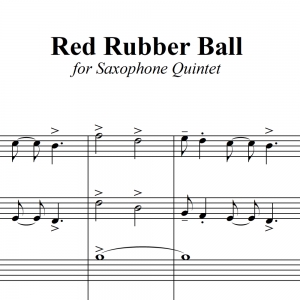
This oldie but goodie by Cyrkle and Simon & Garfunkel is presented here in an arrangement for Saxophone Quintet. All of the parts should be relatively accessible to players of even moderate ability as there are no major range challenges that are taxing to the extremes of any instrument. The technical challenges may come about if taken at a particularly brisk tempo, but even a slightly slower interpretation will sound great.
Performance notes: The key change is present as a tribute to the original recordings, but doesn’t play out here quite the same way. Keys better suited to band instruments are utilized instead, but it can still sneak up on you. If the performers would prefer a shorter performance, the 1st ending could be bypassed altogether.
Also available for Brass Quintet or Clarinet Choir or Solo with Piano
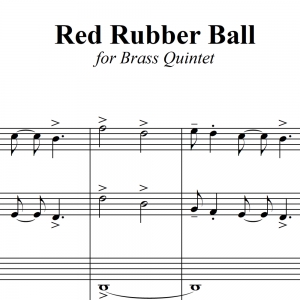
This oldie but goodie by Cyrkle and Simon & Garfunkel is presented here in an arrangement for Brass Quintet. All of the parts should be relatively accessible to players of even moderate ability as there are no major range challenges that are taxing to the extremes of any instrument. The technical challenges may come about if taken at a particularly brisk tempo, but even a slightly slower interpretation will sound great.
Performance notes: The key change is present as a tribute to the original recordings, but doesn’t play out here quite the same way. Keys better suited to brass players are utilized instead, but it can still sneak up on you. If the performers would prefer a shorter performance, the 1st ending could be bypassed altogether.
Also available for Clarinet Choir or AATTB Saxophone Quintet or Solo with Piano
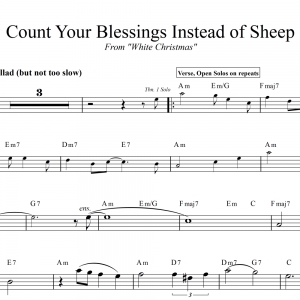
This lesser known holiday-season standard by the great Irving Berlin is available here for 4 Trombones and Rhythm section. This ballad had its debut in the classic film “White Christmas” with Bing Crosby and Rosemary Clooney.
This arrangement was written as a “Head” chart where, after the initial rundown of the melody, the form is repeated for as many soloists as are desired before a final repeat playing the tune and proceeding to the second ending. Chord changes are provided in all parts for flexibility in soloist selection.
For the most part, the ensemble parts are accessible to a broad range of playing abilities, but the top part is the greater challenge for range and melodic lyricism.
Performance options: This ballad runs the risk of dragging along so slowly that it feels interminable. Even at a moderately slow tempo, it’s important to keep things moving. If it feels that the solo section takes too long, it also works well to bring the ensemble back at the “B” section of the melody (meas. 21) for a briefer wrap up.
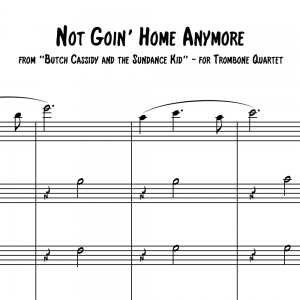
“Not Going Home Anymore” is one of the gorgeous pieces from Burt Bacharach’s score for “Butch Cassidy and the Sundance Kid.” While it should be played as a slow waltz, it’s important not to drag it too slowly. There is ample opportunity to take advantage of suspended chords in the accompaniment throughout.
Instrumentation: This piece is presented here in an arrangement for Trombone Quartet or Trombone Choir. Alternatively, any of the parts could be played by Euphoniums/Baritones, or the Bass Trombone line would work well on Tuba as well.
Performance notes: This arrangement will feature the melodic/legato ballad abilities as well as the range of the 1st trombonist. The remaining parts are not too difficult for most players, but the lead will need to be a solid player. A demo recording (video below) is recorded ½ step higher in pitch.
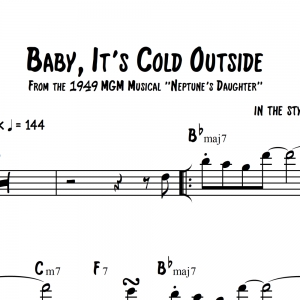
This holiday-season standard is available here for Trombones and Rhythm section as performed by Bill Watrous & Carl Fontana in their amazing recording. The general form and key of their original recording is followed.
This arrangement was written as a “Head” chart where, after the initial rundown of the melody, the form is repeated for as many soloists as are desired before a final repeat playing the tune and proceeding to the second ending. Chord changes are provided in all parts for flexibility in soloist selection.
Performance options: This is a flexible arrangement that can be played with anywhere from 2 to 4 trombonists. Parts 1 & 2 are featured as the duet throughout, but each extra part adds a few extra lines and harmonic density. The top two parts are the most involved but the other two parts will be more accessible to players with lesser experience.
Also available for Saxophone ensemble
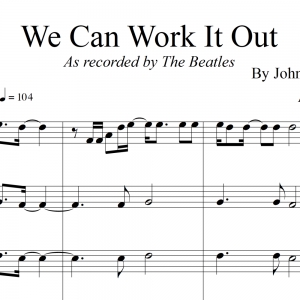
This Beatles classic makes for a nice little tune for unaccompanied string quartet. The form and key of the original recording is closely followed but has been crafted to function with a standalone ensemble without vocals or percussion. This will make a fine addition to a Beatles tribute set or as nice background music for a wedding reception’s cocktail hour.
Performance options: If this feels as though it is going on a little long for the available performance time, taking the Coda during the repeat rather than the DS should trim off enough to make for a still complete performance of the song without taking as much time..
None of the parts should pose much of a challenge for even young players.
"We Can Work It Out" is available for:
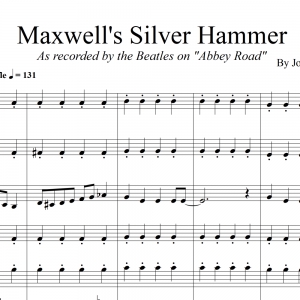
An enjoyable romp from the Beatles’ Abbey Road album shows up here for 5 brass. The form and character of the original recording is generally fairly closely followed. This arrangement is set ½ step higher than the original recording for better accessibility, especially for players not as comfortable with the key of D. Besides the Tuba part (which has some fun twists and turns), every other instrument gets a chance to play the melody for an entire verse or chorus to keep things interesting for all.
Performance options: The first and second verses are fairly identical. Since the lyrics of this song tell a story, it didn’t feel right to eliminate anything from the form. So, for variety’s sake, a different player is featured for each verse. If desiring a shorter play duration, a choice can be made to either feature the F Horn player or the Trombone player (or alternating between them) on the opening section before heading straight into the second ending.
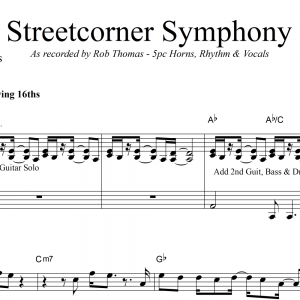
A joyous tune celebrating brotherhood and unity from Rob Thomas, with a 5 piece horn section behind it! The form of the original recording is closely followed but has a little extended tag/playout and a few extra horn licks here and there.
The Rhythm/Lead/Vocal sheet contains chord changes and rhythm section cues throughout.
Performance options: As mentioned, with an extended outro, there are numerous opportunities to make cuts if not intending for this to run so long. The “On and on” tag could even be bypassed by jumping ahead to the Final Chorus rather than going back to the DS.
Optional Violin and Percussion parts are included but they mostly double other instrumental lines throughout.
Also available as a standalone Lead Sheet or with Full Band Accompaniment
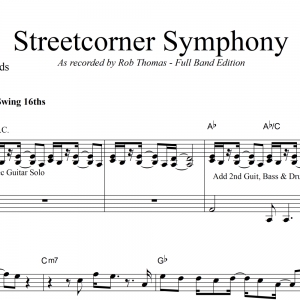
A joyous tune celebrating brotherhood and unity from Rob Thomas, with a full Big Band behind it! The form of the original recording is closely followed but has a little extended tag/playout and a few extra horn licks here and there.
The Rhythm/Lead/Vocal sheet contains chord changes and rhythm section cues throughout.
Performance options: As mentioned, with an extended outro, there are numerous opportunities to make cuts if not intending for this to run so long. The “On and on” tag could even be bypassed by jumping ahead to the Final Chorus rather than going back to the DS.
An optional violin part is included but it mostly doubles other instrumental lines throughout.
Also available as a standalone Lead Sheet or in a reduced 5-horn edition
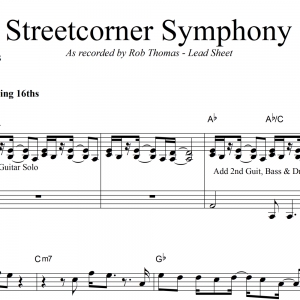
A joyous tune celebrating brotherhood and unity from Rob Thomas! The form of the original recording is closely followed but has a little extended tag/playout.
The Rhythm/Lead/Vocal sheet contains chord changes and rhythm section cues throughout.
Performance options: As mentioned, with an extended outro, there are numerous opportunities to make cuts if not intending for this to run so long. The “On and on” tag could even be bypassed by jumping ahead to the Final Chorus rather than going back to the DS.
Also available with Full Band Accompaniment or in a reduced 5-horn edition
This fun Andrews Sisters-styled vocal feature by Mary Mary is presented here in an arrangement for full big band. The form and key of the original recording is followed.
Individual parts are included for all horn players. The Rhythm section part provides chords and cues to allow full participation regardless of ensemble makeup. Vocal part combines all three parts to a single staff - rehearsal mp3 reference recordings are available upon request.
This fun gospel standard is presented here for TTBB Quartet and Rhythm section.
Flexibility: This arrangement includes optional (but encouraged) Rhythm Section parts. While the chart is constructed that it will work just fine A Cappella, having a at least a pianist on board will kick this one up a notch.
Performance options: The form of the tune is call and response throughout. The end of the first chorus can be treated as a quasi-fermata the first time with the vocals restarting the time, but could repeat back to the instrumental opening as well if desired
This fun classic rock anthem from Queen is presented here for Brass Quintet. The form of the original recording is closely followed but does not include the extended guitar solo playout, skipping ahead to the last three punctuated ending hits. This arrangement is one whole step lower than the record.
Flexibility: This arrangement includes an optional (but encouraged) drum kit part. While the chart is constructed that it will work just fine without it, having a drummer on board will kick this one up a notch.
Performance options: As noted, the form of the original is mostly followed with a few “2nd time only” cues for variety, this can also be streamlined if so desired. The repeated first/second verse section near the start could jump ahead to the second ending to save time. Also, rather than following the transition back to the D.S., a group alternatively could jump straight to the coda having already covered the bulk of the song.
Also available for Wind Quintet or Clarinet or Saxophone Quintets
This wedding reception/dance party standard is presented here in an arrangement for the instrumentation of Alford’s “Hungry Five” series of Polka band books. As this song is meant to be a fun participation number, much interpretation of tempo and form will be left to the performers. It’s best to start moderately slow, then increase tempo a little more every time the D.S. is taken. There is no need to limit a performance to following this road map once through, be ready to repeat it for as long as your dancers are still active...and up to as fast as your players can handle!
Flexibility: The 5 parts will work fully freestanding on their own without drums as the accompaniment can propel itself forward without depending on the drummer alone for the rhythm, so that part is included as a bonus for groups who have a drummer available. Ready to go for your German band's Oktoberfest OomPah gig!
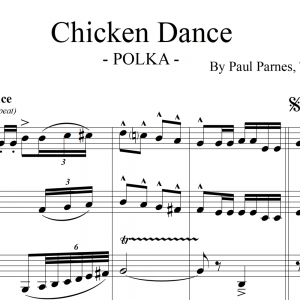
This wedding reception/dance party standard is presented here in an arrangement for Brass Quintet. As this song is meant to be a fun participation number, much interpretation of tempo and form will be left to the performers. It’s best to start moderately slow, then increase tempo a little more every time taking the D.S. There is no need to limit a performance to following this road map once through, be ready to repeat it for as long as your dancers are still active...and up to as fast as your players can handle!
Flexibility: The 5 core brass parts will work fully freestanding on their own without drums as the accompaniment can propel itself forward without depending on the drummer alone for the rhythm. This arrangement’s package includes a sub part for Alto Sax in place of the F Horn.
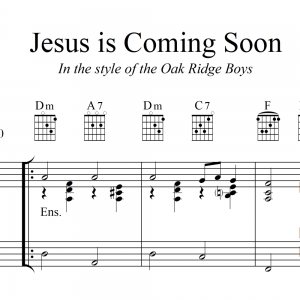
This 70's-era gospel standard is presented here in a TTBB Men's Quartet (or Men’s Chorus) arrangement much in the style as performed by the Oak Ridge Boys. Besides the vocal parts, this arrangement also includes the chord changes throughout (with guitar fretboards) and notated piano introduction.
Range-wise, there are a few things to watch for. The Bass part is intended for a very low voice going down to the low “C” below the staff. The Tenor line spends a good deal of time up at the “G” on top of the staff, and there is also a high “Willie Wynn” - styled solo at the end.
A great addition to either celebratory worship services or special concert settings!
Also available as a TTBB Quartet/Choir with Piano Accompaniment
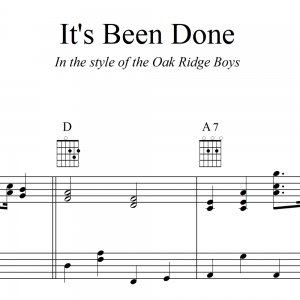
This classic gospel tune bu Garland Croft is presented here in a TTBB Men's Quartet arrangement in the style recorded by the Oak Ridge Boys on their 1976 Gospel album, "Old Fashioned Down Home Hand Clappin' Foot Stompin' Southern Style Gospel Quartet Music." This matches the key and form of the original recording and provides chords and vocal parts as well as a piano intro that should be workable with any number of rhythm section players.
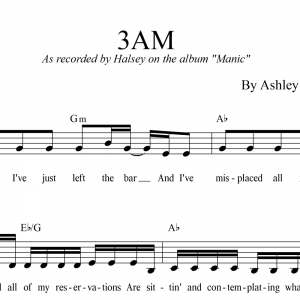
Halsey's 3AM is presented here as a lead sheet/rhythm/vocal/chords chart that matches the key and form of the original recording.
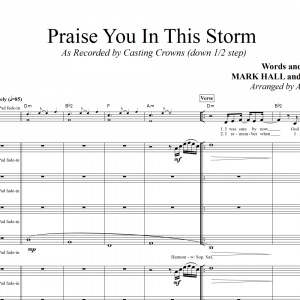
This powerful song from Casting Crowns is presented here as a Rhythm/Vocal Lead Sheet and 4-3-3 horn section. Strings are included along with a synth reduction. The form matches the original recording and is ½ step lower.
Flexibility: This arrangement will work in multiple contexts. Any number of Rhythm players and vocalist will get adequate information from the lead sheet to make for a complete performance. The freestanding String Quartet parts are reduced into the Synth part for additional reinforcement of string lines if so desired, but that part also includes chord symbols to allow for pads in tacet phrases. The horn section parts are unique to this arrangement and add some extra punch to a live performance without interfering with the core of the piece.
Also available as a freestanding Lead Sheet or with just the string section accompaniment
This powerful song from Casting Crowns is presented here as a Rhythm/Vocal Lead Sheet and string quartet. The form matches the original recording and is ½ step lower.
Flexibility: This arrangement will work in multiple contexts. Any number of Rhythm players and vocalist will get adequate information from the lead sheet to make for a complete performance. The freestanding String Quartet parts are reduced into the Synth part for additional reinforcement of string lines if so desired, but that part also includes chord symbols to allow for pads in tacet phrases.
Also available as a freestanding Lead Sheet or full band with strings and horns
This powerful song from Casting Crowns is presented here as a Rhythm/Vocal Lead Sheet. The form matches the original recording and is ½ step lower.
Also available with string section accompaniment or full band with strings and horns
This fun song from Jimmy Buffett is presented here as a Rhythm/Vocal Lead Sheet. The key and form match the original recording.
Flexibility: This arrangement will work in multiple contexts. Any number of Rhythm players and vocalist will get adequate information from the lead sheet to make for a complete performance. Additionally included is a pair of Saxophone parts that are provided in proper transpositions for Alto or Tenor Saxophones, so flexible instrumentation can be accommodated. Additionally, if you happen to have a steel drum player handy (or even a nice keyboard patch) a Steel drum part is included to add a little extra “island” flavor!
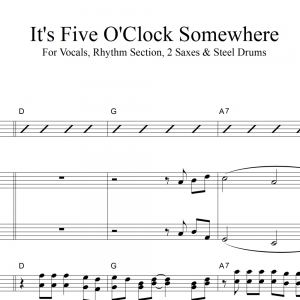
This fun song from Alan Jackson and Jimmy Buffett is presented here as a Rhythm/Vocal Lead Sheet. The key and form match the original recording.
Flexibility: This arrangement will work in multiple contexts. Any number of Rhythm players and vocalist will get adequate information from the lead sheet to make for a complete performance. Additionally included is a pair of Saxophone parts that are provided in proper transpositions for Alto or Tenor Saxophones, so flexible instrumentation can be accommodated. Additionally, if you happen to have a steel drum player handy (or even a nice keyboard patch) a Steel drum part is included to add a little extra “island” flavor!
This empowering song from Taylor Swift is available here as an arrangement for String Quartet. The form and key match the original recording.
In this arrangement, all 4 string parts get the opportunity to play some active and interesting lines. The active rhythmic nature of the original song may pose a slight challenge for younger or less experienced players.
This song is also available as a Rhythm/Vocal Lead Sheet, Clarinet Quartet/Choir or SATB Saxophone Quartet